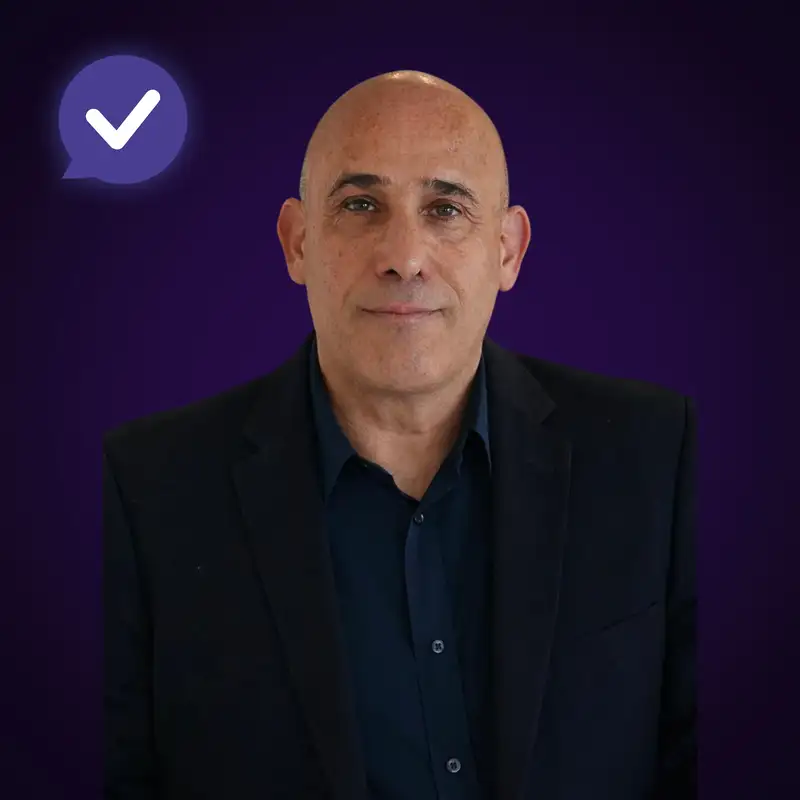
There Is Nowhere Else: Israeli Security, Zionist Pride, and the Doctrine That Broke on October 7 | With Brig. Gen. Amir Avivi
THT Amir Avivi X Audio_3.txt
English (US)
00:00:00.000 — 00:00:08.080 · Speaker 1
I know it's hard to understand it and maybe harsh what I say now. Diaspora is over.
00:00:09.680 — 00:00:11.280 · Speaker 1
It's over. There is no future.
00:00:15.240 — 00:00:38.520 · Speaker 2
Welcome to the honest. Take the show that goes past the headlines to find out what's actually true about Israel and the people covering it. I'm Ben Chertoff, and my guest today is Brigadier General Amir Abidi, a 30 year veteran of the IDF who built Israel's largest movement of security professionals and who wrote the book on a war that was coming six months before it came.
00:00:42.320 — 00:01:56.880 · Speaker 2
Every American of a certain age remembers exactly where they were on the morning of September 11th. For Israelis, that morning was October 7th. Amir Avi saw it coming. Deputy commander of the Gaza division. Chief of staff to the defense minister in six months before Hamas broke through the fence. On October 7th, he published a book called No Retreat that laid out the war that was coming almost to the letter.
Nobody in power listened. He'll tell you why. And it goes back to a Cold War idea most Israelis can't stand. This is a conversation for anyone who's ever looked at a map of Israel and not quite understood what they were looking at. A country 45 miles wide, nine of them along the coast, where the hills your enemies want are close enough to see from the airport.
We get into how Hamas actually came to power, why Avi says Israel can never simply walk away from the West Bank, and his answer to a question most people won't ask out loud. What is the real solution to anti-Semitism? Some of what he says is going to be hard to hear. That's rather the point. General Aviv, welcome to the honest take.
00:01:57.000 — 00:01:58.910 · Speaker 1
My pleasure. Thank you for having me.
00:01:58.950 — 00:02:39.150 · Speaker 2
General, I want to start not with policy, but with a feeling my American audience actually lived through for us. There was a morning, September 11th, when the thing we told ourselves could never reach us did. October 7th was that morning for Israelis. You were a career soldier, watching it unfold in real time.
Can you take me through what you remember to that day? Every American who lived through nine over 11 remembers that first hour where they were. Um, for you, what did you understand in your gut that day that the rest of the world didn't?
00:02:39.190 — 00:05:29.020 · Speaker 1
So in order to explain that, we have to put things in context. You know, when I retired after 30 years of military service, you know, I felt that there was something deeply wrong, you know, in the way the military leadership and the leaders of the nation were looking at our national security. I felt we are in a very big danger.
And, you know, with elaborate later on, how did I get to these conclusions? But this is what I was feeling. And, uh, I felt that, you know, the national security, um, I would say atmosphere in Israel was dominated by generals that for many years pushed policies of concessions, retreats, weakness in a way past Zionism.
Um, and I knew that, you know, most of the officers don't think like that. The Zionists are winners and the standing issues on the ground. They were not organized. And, um, several years before the 7th of October in 2020, in January 2020, I established a new movement and think tank or tank, um, to really change, you know, this reality to, to bring an understanding of the challenges and the Through the activities of this new organization, known in Hebrew as a team in English at IDF, Israel's Defense and Security Forum, two years before the war, already understood that war is coming, and we wrote a very extensive national security assessment describing this war that is going to come and saying we have only two choices.
Or a six day war scenario or a young people scenario. We need to choose either we will be proactive and will attack first, or we are going to be attacked by surprise. So in this context of somebody who is leading or lead at the time, you know, a big movement, um, that saw this coming, saw this were coming and not only produced a very extensive national security assessment that was presented to the previous government and this government and Mossad and the president and so on.
But based on this assessment, I also wrote a book, No Retreat. It was published six months before the war, describing the whole world that is going to come and what will happen after the war and what is the long term vision to secure Israel. So at 630 in the morning, when my wife Anat, who volunteers as an ambulance driver, so she started getting messages, you know, from mother, from the Israeli equivalent of the Red cross.
Then there'll be the dome that, you know, something big is happening. And because she knew all our assessments when she woke me up at 630 in the morning, she said, I'm here. The war started. We are in a war.
00:05:30.780 — 00:05:46.699 · Speaker 1
The first thing that went through my mind is, you know, it took me a minute to understand that it's Hamas attacking. And the first thing that went through my mind is, why isn't Hezbollah attacking Iran? The Palestinians, Jordan summarized well, the Arabs we fought so
00:05:47.940 — 00:05:52.100 · Speaker 1
a an attack, a simultaneous attack from all fronts
00:05:53.170 — 00:06:53.370 · Speaker 1
And and it. What surprised me. It's not that there was an attack because this we foresaw. It surprised me that it's Hamas attacking alone. Yeah. Um, and, um, the second thought that went through my mind was, okay, what are Hamas thinking? I mean, why, what are they doing? I mean, it's crazy. Yes, they surprise us.
It's a big surprise. Of course, I was also surprised that with all the intelligence we have, with all our capabilities, you know, the Army didn't see it coming. This surprised me a lot. I mean, there is a difference between the fact that we knew that there was that deeply wrong kind of thinking in the Israeli establishment about their intentions and what they want to do.
But you wouldn't expect a reality where 4 or 5000 nobody are getting ready to storm, ready to storm Israel. And we don't know about that. It's crazy.
00:06:53.410 — 00:06:54.170 · Speaker 2
Right?
00:06:54.770 — 00:08:06.890 · Speaker 1
So this surprised me. But I can tell you that two, three, four hours into the war, when we assess the situation after talking to the commander of the North and making sure, you know, they mobilize the whole army to the north to make sure that Hezbollah doesn't go in. And when we understood that the Sudan summarized under control, Israeli Arabs are not shooting, Iran is not shooting, it's just Hamas.
When we assess the situation four hours into the war, my organization, we knew we are going to win. And this is an understanding nobody had. We everybody was in a complete shock. The government, the society, the army, the Shin Bet, everybody was shocked and we said, that's it. We're going to win. Because the moment it was just Hamas, we knew at that moment it would take us a day or two to kill all of them on our side.
Push them back to Gaza. Now we're mobilizing hundreds of thousands of soldiers, you know, to the reserve. And we knew when this war machine of Israel will start moving.
00:08:08.530 — 00:08:18.770 · Speaker 1
It will accelerate and accelerate and accelerate to to the point where. Once we are in full scale, you know, there is no force on earth that can stop us.
00:08:19.010 — 00:08:19.530 · Speaker 2
Mhm.
00:08:20.370 — 00:08:39.930 · Speaker 1
Um, and we knew we knew it's going to be a very long war. We knew it will take years, but we also knew that, uh, in a way, in a very terrible way, devastating way. Israel was saved because when we put this assessment, talking about this upcoming war,
00:08:41.370 — 00:08:49.850 · Speaker 1
we put on the cover of this assessment a picture of a frog being boiled in a pot. And we said, This is Israel. Israel is dying.
00:08:51.640 — 00:09:46.320 · Speaker 1
We saw four major challenges that Israel and the Jewish people were facing, and none of them were taken care of. One is this big war, Iran and all proxies. So basically this whole war we are talking about now. One threat out of four, which we outlined in our assessment, the second threat. We talked about the challenge that inside the land of Israel, in the Negev, in the Galilee, in Judea and Samaria, everything that's going on inside the borders of the land of Israel.
It's a huge challenge which is not taking off. We talked at length about delegitimization and anti-Semitism two years before the war. Wow. We looked at anti-Semitism and delegitimization as an existential threat to Israel and the Jewish people. Two years before the war. And last but not least, we talked about our
00:09:47.480 — 00:10:25.480 · Speaker 1
problem with our identity. The fact that Jews are distancing from core Jewish Zionist values, we saw we fall. So, you know, the social crisis we saw, we said. We said, because there is no common vision. This is bringing friction into the society, but also in the relationship between Israelis and the diaspora.
It's all about, you know, our identity, our connection to our ethos as a nation. And we said and I said it in the book to us before the war, we need to go back to be the heroes of our own story, not the villains in our own story. We forgot we are the heroes.
00:10:26.400 — 00:10:36.640 · Speaker 2
What does it feel like to have had a really a prescient view of what was going to happen, and then to see it actually happen?
00:10:37.240 — 00:10:43.200 · Speaker 1
Look, that morning, I felt I felt three different emotions at the same time.
00:10:44.280 — 00:10:59.350 · Speaker 1
One, I was really angry on our decision makers. We told them. We showed them this assessment. We told them exactly what's going to happen. Now, this is not just giving someone a paper. I brought with me to every meeting, ten, 12 generals.
00:11:00.830 — 00:11:34.070 · Speaker 1
We sat in front of all these decision makers. We explained at length what's going to happen. They cannot say they didn't know we did conventions. We did videos. You know, we put a lot of effort. They didn't listen. And by the way, I write in the book six months before the war, why they're not listening. It's also something that bothered me because, you know, we're telling them war is coming.
They were not listening. So I talk about what we call in Hebrew, the Concepcion. You know, the reason why, you know, they were not willing to deal with reality.
00:11:34.990 — 00:11:37.270 · Speaker 2
Um, what was that reason?
00:11:38.070 — 00:11:38.710 · Speaker 1
So
00:11:39.870 — 00:12:09.430 · Speaker 1
basically, Israel, in a way not formally, but practically Embraced the American doctrine against the USSR. You know, in 1946, after the Second World War, the US has itself. Okay. How are. How are we going to deal with the USSR? You know, the threat. And in 1946, the US embraces a doctrine. And they call this doctrine containment.
00:12:10.510 — 00:13:06.419 · Speaker 1
When you say to Israel is containment, they get crazy. They hate this world, hate it, and they are lamenting all the time. Why are we containing what is this containment? You know, the containment is a when you talk, what is the conceptual? Israelis will tell you. Containment. But for the US, it worked amazingly well.
I mean, you know, the US decided not to confront directly the USSR, but to deal with them where they are trying to expand. Whether it's North Korea, Vietnam, Cuba, um, and then the US added another element which was very crucial. A space and military race. Thinking that the USSR is not going to be able to to to cope with this, you know, because the USSR, the communist economy not advanced one and the US was a very advanced economy
00:13:07.580 — 00:13:54.060 · Speaker 1
and indeed an amazing thing happens. You know, at the end of the 80s, the USSR, USSR collapses without even one bullet being shot at them. Amazing, amazing success. For, for for, you know, a doctrine that's based on containment. Now, what happened in Israel? Same thing the government said and the army and so on.
We don't want to be war. We want to we want to avoid a war. So let's contain it. You know, let's if we need to do a pinpointed operation in Gaza or somewhere else, okay, we will contain this. We're not going to do big wars, and at the same time we'll develop our economy. High tech will boom tourism. You know, Israeli, um,
00:13:55.260 — 00:15:04.900 · Speaker 1
GDP per capita went from $15,000 all the way to $55,000. Now it's almost 60 or 70,000 thousand dollars. And at the same time, something amazing happened. The reality in the Arab world, uh, you know, became very problematic. You had the Arab Spring. We saw country after country, the Arab world collapsing completely economically, socially, militarily, I mean, Egypt, Syria, Iraq, Yemen, Libya, you know, all these places collapsing.
And then, you know, our government and the security establishment there, look at this reality. And they say, look, it's working exactly the same. It worked for the US. We are thriving. Well developing, we are growing, we are avoiding big wars and they are collapsing. And it's just a matter of time. If we just manage to push these wars away a bit more, you will see at the end of the day Hamas would collapse, Hezbollah will collapse, Iran will collapse.
They are all in a really bad shape.
00:15:06.100 — 00:16:12.370 · Speaker 1
They really wanted to believe that this will continue. And I think the difference between us in IDF and the government and the military and so on, is we saw the shift, we saw the moment where we knew this is not going to work anymore. There was a period of time where I was thinking, yes, you know, it's working for us.
But then there were huge global and regional changes that brought us to the conclusion that that's it, this is not going to work anymore. And recognizing the moment of shift, it's very, very hard because human nature is wanting to believe that what has been working well for a long time will continue to work well.
This is, you know, this is how human beings, even the most a the best businessman in the world, usually when they see, you know, the stock market going up and up and up and up, they say, okay, this the rally will continue. You know it's bullish. It will continue being bullish. And it doesn't work like that.
There is always a collapse at the end of the day. And most of the people, even the most able ones, they don't see it coming.
00:16:12.410 — 00:16:23.770 · Speaker 2
What do you think that. I mean, what for you? What? What was the change? The global change and shift that you saw that shattered the containment fantasy for you?
00:16:24.170 — 00:17:09.970 · Speaker 1
So, you know, we've seen for many years American dominance in the Middle East, America was strongly present in Iraq, in Afghanistan and projected its power in the region. Um, but I think that from President Obama and all the way to President Biden. American leadership, global leadership started diminishing more and more.
And one of the defining moments was the withdrawal from Afghanistan, when the US withdrew the way it did in Afghanistan, it went back 20 years back. You know, immediately, you know, um, all the achievements were raised in a day.
00:17:10.770 — 00:17:11.329 · Speaker 2
Mhm.
00:17:11.850 — 00:17:22.730 · Speaker 1
Um, this sends a very strong message globally to Russia, to China, but also to Iran and to the Middle East overall. The US is done,
00:17:23.810 — 00:17:51.360 · Speaker 1
is weak, is retreating. They lost willingness to fight. What does it matter how many capabilities and technologies you have if you don't have the will to use them? And the feeling at that time was, that's it. The U.S. is done. And this, by the way, encourage the Russians to invade the Ukraine. Are you a strong us?
A reality of a strong us would have prevented such an invasion that wasn't there,
00:17:52.600 — 00:18:18.560 · Speaker 1
but us was perceived, you know, at a very weak moment. And then you saw Russia attacking. And at the same time, because of the dynamics of the Russian-Ukrainian war. Suddenly you saw a Russian, Chinese, Russian, Iranian front emerging in the Middle East with an alignment between China, Russia and Iran.
Iran at that period of time really reached,
00:18:19.760 — 00:18:27.560 · Speaker 1
after many, many years, a serious buildup of capabilities. Suddenly they are backed up by China and Russia. America is withdrawing
00:18:28.720 — 00:19:17.640 · Speaker 1
and at the same time looking at Israel. Complete mess, five consecutive elections, a society that seems broken. A Political system that is not functioning. And when we connected all these dots, we said, okay, that's it, we're on our way to the war. And we said, look, this war might start in several ways.
One way is that we get to the conclusion, that's it. We cannot wait anymore. Iran is moving towards nuclear weapons and we need to attack. And it was obvious that if we attacked, then the whole ecosystem of Iran will attack us back. And this is going to be a multi front war. The other option was that they see us in our weakness and they will say, okay, this is our moment now let's attack Israel
00:19:18.680 — 00:19:22.040 · Speaker 1
and attack. We expected to see a simultaneous attack.
00:19:23.400 — 00:19:33.400 · Speaker 1
Um and it could have been certain I don't know local operation that, you know, brings us to a whole war.
00:19:35.280 — 00:19:42.830 · Speaker 1
Uh, so one way or another, it didn't matter which scenario would happen. It was obvious that we were going to work. To us, it was obvious.
00:19:43.990 — 00:19:54.790 · Speaker 1
Um, so on the 7th of October, I wasn't surprised that I was startled. I was surprised the way it started. The fact that it was only Hamas,
00:19:55.870 — 00:19:58.790 · Speaker 1
um, and I can tell was.
00:19:58.790 — 00:20:08.870 · Speaker 2
That, I mean, Hamas had expected involvement from Hezbollah. Why did that not happen? Was that just a massive miscalculation?
00:20:09.510 — 00:20:36.070 · Speaker 1
It's very hard to say. You know, that morning I was thinking that I said, okay, Iran is launching Hamas to an attack in order to stop the normalization between Saudi Arabia and Israel. It was obvious that once we were about to achieve normalization, this was a huge, huge threat to Iran. So they said, okay, we will disrupt this.
We will launch an attack. And I was thinking, maybe Iran wants to keep Hezbollah intact
00:20:37.230 — 00:20:50.510 · Speaker 1
because I don't want to lose both proxies. You know, they need a strategic depth. And then another option came to the table, which was that Iran knew how penetrated Hezbollah was.
00:20:51.790 — 00:21:03.710 · Speaker 1
And they said, oh, if we let Hezbollah know all the plans, then Israel will know that something is happening because they have much more intelligence on Hezbollah than Hamas.
00:21:04.950 — 00:21:12.390 · Speaker 1
But then it might be some kind of a, I don't know, lack of tactic coordination. A
00:21:13.670 — 00:21:44.790 · Speaker 1
Hamas want to attack too fast. And, you know, Hezbollah wasn't ready. It's not clear. But the fact that it was just Hamas, this changed everything. This gave Israel a huge opportunity at that moment. And I can tell you that, um, you know, during the day after we assess the situation and we were working to save people in the in Gaza and making sure that the army also secures the north and Judea and Samaria.
At a certain point, my deputy in India,
00:21:45.950 — 00:21:59.750 · Speaker 1
who is the chief operations officer of the Gaza division, in reserve. You know, he came to the Gaza Division, the the the division was conquered by Hamas. They sent him to open an alternative headquarter.
00:22:00.790 — 00:22:30.190 · Speaker 1
And I said to him, you know, I'm on my way. He said, no, no, no, no, listen, you have to go now to national TV. If you don't speak to the people of Israel this morning, this country today is going to collapse. Nobody is talking to them. So I went to the TV station, all of them, all the major TV stations on the 7th of October and from that day, almost every day.
And, you know, I came to the station, everybody was in a complete shock. And they look at me, I'm the general, you know?
00:22:31.670 — 00:22:45.979 · Speaker 1
And I said, look, guys. Yes, it's a very difficult moment. It's devastating. The sites from Gaza are terrible. But I want you to know the strategic situation. We secure the north. We secure Judea and Samaria. We secured our internal
00:22:47.220 — 00:23:47.060 · Speaker 1
situation. We're fighting in Gaza. I'm telling you now, it won't take us more than 2 or 3 days to kill all of them on our side. We'll push them back to Gaza. And from that moment onwards, we are taking the initiative. Hundreds of thousands of Israeli soldiers are on the way to the borders and the units. And when we will take the initiative, this war eventually will end with a decisive win on all fronts.
Yes, it's a very big crisis, but it's a big opportunity and we're going to seize it. We're going to win this war. And this message was very, very, very important to the Israeli nation and many people. You know, when I walk in the streets, people come to me and say, Amir, you saved us. You know, it's really what made the difference.
You know, in the first few days when we said, guys, we're going to win. Yes, it's hard, but, you know, it was amazing to me to see many generals and public figures
00:23:48.220 — 00:24:13.340 · Speaker 1
that after the 7th of October, stayed in the 6th of October with the same petty, petty discussions with the same politics. Bibi, not Bibi, they didn't fly to the moment. You know, I could have come on the 7th of October to the TV with my assessment and my book and said, I told you so. You did not listen to us. You need to resign.
00:24:14.180 — 00:24:14.580 · Speaker 2
Right?
00:24:14.780 — 00:24:31.210 · Speaker 1
I didn't do that. I said, it's not relevant. What's the relevance here now? You know, as much as I was angry on all the decision makers in the army and in the government, it's not what's not relevant, right? We need to empower the now. We need to win the war.
00:24:32.410 — 00:24:35.410 · Speaker 1
So I gave the message of hope. Not, you know,
00:24:36.690 — 00:24:46.210 · Speaker 1
dealing with attacking them. You asked me how I felt that day. So one thing, you know. Really, I felt really angry about all this politics. Yeah, yeah. But also,
00:24:47.370 — 00:25:04.050 · Speaker 1
you know, there are officers, generals that are born for everyday stuff in the army, and they are officers in the general that were born for war. And we are the kind of people that were born for this moment. And when we see a crisis like that,
00:25:05.530 — 00:25:06.649 · Speaker 1
we feel
00:25:07.730 — 00:25:33.170 · Speaker 1
full of spirit. You we feel that, you know, this is the defining moment. We feel empowered. We feel that, you know, we have to do big things. We have to win and not small kind of feelings, you know? So I felt, you know, okay, this is a historical, I would say even biblical moment. And I understood how big this moment is, you know, But I must tell you, I also felt, um,
00:25:34.770 — 00:26:08.010 · Speaker 1
I felt guilty. Yeah, I felt that, you know, I'm one of the few people that actually knew what is coming. So, yes, I built a movement and I wrote, you know, National Security assessment, and I wrote a book, and I presented it to many people, and I did videos, but all the time I felt on the 7th of October I didn't do enough.
I felt that I probably could have done more, shouted more. You know, I felt like powerless. I felt, you know, that, um.
00:26:10.170 — 00:26:21.530 · Speaker 1
I was thinking to myself, you know what? What could you have done more to to to to really, really make, you know the government, understand the army, understand that war is coming. They were not listening. And
00:26:23.010 — 00:26:27.570 · Speaker 1
I couldn't, you know, not feel that maybe we could have done more.
00:26:28.960 — 00:27:15.200 · Speaker 2
Can you? Before we get into the the forward looking policy issues, I think it's really important, especially for an American listener who hasn't been to Israel, to understand how compact the country is, especially when you're talking about the idea of containment. Um, you know, I think a lot of the audience in America has a longer daily commute than the width of the country in some areas.
Um, what's it like to raise kids and live your whole life in a place where you can see really like you, Ben-Gurion. You can see the West Bank, where you can see where the threats are from your house, where soldiers go home on the weekends.
00:27:16.280 — 00:27:25.720 · Speaker 1
To compare it to the US. It's like living in Manhattan and seeing the other side of the Hudson. And your enemy is exactly on the other side,
00:27:26.760 — 00:27:28.520 · Speaker 1
even closer. And it's not a
00:27:29.640 — 00:27:34.560 · Speaker 1
canal or sea that between you. It's just a few hundred yards.
00:27:35.600 — 00:27:52.160 · Speaker 1
Um, between 50,000 murderous terrorists with rockets, anti-tank missiles and drones and improvised explosive devices in your towns. And these people, they just one thing. They want to annihilate you. They want to kill you.
00:27:53.320 — 00:28:13.480 · Speaker 1
Um, you know, looking at the land of Israel, the weeds of the whole land, all of it with Judea and Samaria, what people call the West Bank from the shores of Tel Aviv to the Jordan Valley, to the border with the state of Jordan. It's 45 miles. It's not even a city.
00:28:14.520 — 00:28:38.640 · Speaker 1
This is the land of Israel. 45 miles. Yep. And you know, it's nine miles offshore, nine miles of Jordan Valley. And the rest of the land of Israel is the mountains of Jordan. Samara. So basically, the land of Israel is the mountains of Judea, Samaria with a bit of margin. That's it. Yeah, yeah, the whole land.
This is why all the history of the Jews on the mountains, if you are out on the mountains, you cannot exist.
00:28:38.960 — 00:28:51.840 · Speaker 2
So you've described your worldview as absolute security control. Can you give me a one sentence version? What does absolute security control mean and what does it cost?
00:28:53.000 — 00:29:30.310 · Speaker 1
Okay. So first when we talk about Israel's national security, the most important thing for for us, for me, in national security is understanding that national security is first and foremost about national values. It's about our deep connection to Judaism and Zionism. The sense of rightness. It's if the biggest issue is the will.
We talked about the US. What happens with a country that has endless amount of capabilities and zero will to use it. Okay. National security starts with a sense of purpose,
00:29:31.670 — 00:30:02.109 · Speaker 1
and the sense of purpose comes from the connection to our Jewish Zionist values. And this this sense of purpose is the fuel for will. Once you have a sense of purpose, you have the will to to endure many challenges, you know, throughout the years. So we work a lot on, on the, on on the issue of the spirit. It's all about spirit.
Okay. This is the most important a weapon
00:30:03.230 — 00:30:53.230 · Speaker 1
you have. And this is first understanding the first. The second understanding is that Israel and I wrote about it in the book before the war. Now the Prime minister talks about it almost every week. Israel must be able to defend itself by itself. We cannot rely on anybody. Yes, we need partners. Yes. The US is our biggest friend, but when it comes to our existence, we need to be able to have huge military industries, produce our own munitions and have an army big enough to endure long wars and have a energy independence of as much as possible, food independence, and certainly an ability to produce the critical things we need for war.
00:30:54.790 — 00:31:26.860 · Speaker 1
We're not going to be like disconnected from the world. But again, you never know what will happen. You have to have these capabilities, and then you need to reside along defensible borders. And the minimal defensible borders are the land of Israel are the Jordan Valley, the Golan Heights. Um, and we need to control all the perimeter around this one.
So Jordan Valley is on one side, but Philadelphia and the Egyptian border on the other side.
00:31:27.020 — 00:31:27.540 · Speaker 2
Mhm.
00:31:27.700 — 00:32:05.979 · Speaker 1
Um, and we need to be overall. Uh, only Israel can have an army inside the land of Israel. Because again, 45 miles cannot have another army inside 45 miles. When I talk about solutions, before I talk about solutions, I talk about the methodology, how to think about it. And what I suggest is four steps. Step one don't mix your values with problem solving.
You cannot put a hole in the holistic idea of Judaism and Zionism
00:32:07.180 — 00:33:04.219 · Speaker 1
in order to solve a problem. So our holistic idea is very clear. We are the people of Israel. This is the land of Israel. It's our land where the ancestral people of this land where the indigenous people of this land And we're not trading our values to solve for problem solving. This is our basic values. We're not coming and saying we are occupiers in our own land.
No, we are not. This is our land. Okay. So you don't mix up your values with problem solving. It doesn't mean by the way you disregard problems. It doesn't mean you don't look at reality and try to solve problems, but you're not. You don't need to sell your identity to solve problems. It's two different things.
You don't mix values with problems. So that's if you are not aligned here. You know, we already have nothing to relevant to discuss because if we are occupiers in our own land
00:33:05.260 — 00:33:19.860 · Speaker 1
okay. So maybe we shouldn't be here. If we are, according to some people, Europeans that came to a place that doesn't belong to us. The conclusion will be we have to go back to Europe, right? What are we doing here?
00:33:21.050 — 00:33:47.130 · Speaker 1
so you don't mix our bodies. Second thing is, you don't talk about them before you are able to define clearly what are your red lines? Or in other words, what is needed to secure Israel for generations to come. Looking a thousand years ahead, not ten years ahead, a thousand years ahead. I always say that a nation that has been around for thousand years, it was at least be able to think a thousand years ahead.
00:33:48.970 — 00:33:50.370 · Speaker 1
Nobody knows
00:33:51.570 — 00:33:58.210 · Speaker 1
what dangers there will be, what technologies, what empires will rise. Nobody knows anything.
00:33:59.450 — 00:34:40.450 · Speaker 1
So the way you approach it is you have to say, okay, I don't know what the future holds, but let's look at really dramatic scenarios. How do I survive it now, when you have a nation that has been expelled from its land Fourth times Assyrians, Babylonians, Romans, Muslims, 2000 years in the diaspora, persecuted, thrown from place to place, humiliated.
A third of our people were exterminated on European land in the Holocaust, in concentration camps.
00:34:41.810 — 00:35:07.850 · Speaker 1
You would expect that a nation like that will put a huge, huge effort in answering the question, what is needed to secure Israel for generations to come? And it's amazing that before the creation of DSF, before I founded this movement, there was not a single think tank,
00:35:08.970 — 00:35:14.610 · Speaker 1
research department, government that answered this question
00:35:16.130 — 00:35:39.969 · Speaker 1
how can it be? We were expelled four times. We are experiencing endless wars in operations and nobody is taking seriously the question what is needed to security for generations to come? Now, only when you answer this question, then you set the parameters of what can be a solution or cannot be a solution.
What are your red lines? This one has no red lines
00:35:41.490 — 00:35:43.290 · Speaker 1
and we need to define them.
00:35:44.370 — 00:35:52.730 · Speaker 1
And this is what I've been doing in the last few years. Defining the red lines. The minimal red lines needed for us to exist.
00:35:53.130 — 00:35:55.170 · Speaker 2
What what are those red lines?
00:35:55.570 — 00:36:27.920 · Speaker 1
So basically, Israel cannot be smaller than the land of Israel. These 45 miles are the minimum for existence that the minimum, not the maximum. Maximum might be more, but the minimum. So this brings us to the next step. The next step is defining the problem. So you have people saying, look, the problem is that you guys are occupiers.
So retreat and the occupation, that's it. The problem will be solved very easily. Right?
00:36:27.960 — 00:36:28.600 · Speaker 2
Right.
00:36:28.640 — 00:36:36.999 · Speaker 1
Well, I don't think it's a good definition of the problem. Okay. I think that the problem is how do you bridge
00:36:38.080 — 00:37:15.520 · Speaker 1
between our national security needs to exist on the mountains of Judea, Samaria, and in the Jordan Valley, in the, you know, even in Gaza and other places, and at the same time find a solution that is according to international law and doesn't require a annexing to 3 or 4 million Palestinians. So you want to be secure.
You want to be connected to your heritage and history and live along the Bible Belt and in the places that are important to you, because this is not just about,
00:37:16.560 — 00:37:42.760 · Speaker 1
um, hardcore security. This is about spirit. If you disregard your history, your Bible and everything, you won't exist. There will be no spirit. So you have to be a bridge between these two needs. You need to be connected to your heritage and history and be secure. And you need to find a solution, not to annex all these people and find a solution that adheres to international law,
00:37:43.840 — 00:38:47.270 · Speaker 1
not what people think is international law. Read international law. Okay, so this issue fascinates me. For years I've been dealing with this. I wrote in my book four different solutions to the Israeli-Palestinian conflict. In all of them, I don't undermine not our history, not our heritage, and not our security.
So what I found out is that while our national security needs are very, very rigid. Statecraft is almost endlessly flexible. There are many, many solutions according to international law which can be applied. It's very flexible and we need to adjust. You know the right solution and there is never one solution to a problem.
You always have several possible solutions. And that might be a, you know, push forward. And I was always asked okay what's your favorite solution? I said, no, no, no. It's a matter of context. You know, depends on reality on the ground.
00:38:48.350 — 00:38:52.670 · Speaker 1
And so we need to bridge between these two issues.
00:38:53.830 — 00:39:16.670 · Speaker 2
So there is and you talked about this. You touched on it for a moment. There is a especially in the West this this sense of why don't you just leave Judea and Samaria? Why don't you just leave the West Bank and leave it to the Palestinian Authority and everything will be fine. That'll solve everything.
00:39:16.750 — 00:39:23.830 · Speaker 1
So they're basically what happened. They're basically calling for the complete annihilation, destruction of Israel
00:39:25.510 — 00:40:04.590 · Speaker 1
to exist. Israel cannot exist on the shore in a country with the width of nine miles. I don't know, any country can can exist in nine miles on the shore. And again, you know, sometimes I hear even from, you know, parts of the Israeli left, you know, but one day we'll find a Palestinian Ben-Gurion who will really, really mean peace, you know, and I'm saying, listen, guys, this is not relevant because the question is not if we have 10 or 20 years of peace.
The question is, what happens when you don't have peace? Now, look, I was, you know, deputy division commander of the Gaza Strip. I served there twice. And, um,
00:40:05.830 — 00:40:56.820 · Speaker 1
I remember, you know, when I was deputy division commander, there were many groups coming to visit. You know, they were sending me to brief them. We used to stand in a site called Black Arrow overlooking the north part of Gaza, and it was always the same, you know, I would we would stand there and then I was a colonial at the time.
They would ask me, colonial what's going on in Gaza? And I would say to them, you know, basically from the day of the judges in the Bible. Same thing. You know, the Gazans attack us, we bring the people, we fight back again and again and again. When you read the book of judges, Samsung and all these famous stories and you look at the reality today, you get to the conclusion, nothing change.
Same same dynamics, you know? But at the end of the book of judges, after many wars with the Gazans of that time,
00:40:58.420 — 00:41:23.820 · Speaker 1
it said, and the land was quiet for 40 years. And the rabbis asked, why does the Bible need to state that? You know, every word in the Bible has a meaning. And the answer was that 40 years of quiet in the land of Israel is an event of biblical dimension. It never happened in 4000 years. So when we think about national security and the existence of the Jewish people in their homeland.
00:41:25.020 — 00:41:32.580 · Speaker 1
You when you want a solution, the question you need to ask yourself once there is war.
00:41:33.620 — 00:41:37.060 · Speaker 1
Is this solution viable or not? Not peace more
00:41:38.860 — 00:41:59.180 · Speaker 1
because human history is paved with much more worse than peace times, you know. And war will come when? In one day. Okay. Even if you think that you reach 40 years of quiet. So you need solutions that will stand even if there is a very big war.
00:42:00.620 — 00:42:02.659 · Speaker 1
And without you, then somewhere
00:42:04.500 — 00:42:09.340 · Speaker 1
we cannot exist. Not spiritually, not physically, not in any form.
00:42:10.340 — 00:42:48.620 · Speaker 2
You were on the ground in Gaza way before the the withdrawal. I mean, I've heard you talk about being there in 96 when after Oslo, uh, security forces pulled out of the cities and they weren't going to operate in the cities. And that left a power vacuum. I mean, I think you've explained that that's an analog for what would happen in the West Bank if there was just a sudden withdrawal.
But can you explain for American audiences who really don't understand the history of the withdrawal of Israeli forces from Gaza, what happened and what you saw?
00:42:49.060 — 00:43:05.260 · Speaker 1
Okay. So Israel liberated Gaza from the Egyptians in 67, from 67 all the way to Oslo in 94. Gaza was at the Stone age, literally. It posed no danger to Israel.
00:43:05.340 — 00:43:05.900 · Speaker 2
Mhm.
00:43:06.140 — 00:43:24.210 · Speaker 1
Yes. We had in 87 the First Intifada. But again, there was one stones, you know, it was. Occasionally there was maybe a local terror attack, but but really as a whole. Gaza was not a strategic issue. And this is why, by the way, in Oslo, when Israel had to do some kind of a,
00:43:25.530 — 00:43:28.690 · Speaker 1
you know, take a decision where you want to take chances.
00:43:30.210 — 00:43:48.090 · Speaker 1
They said Gaza and Jericho first. Why? Because Gaza was a non-issue, a non-issue. It wasn't considered a problematic place. So when when Israel did a risk management, they said, let's start in the places which are less problematic.
00:43:49.290 — 00:44:44.449 · Speaker 1
And in 94, the way we we managed the risk, we said the road of Philadelphia, the border with Egypt, we're going to keep it. We're not going to evacuate any Jews. We stayed in Gush Katif and that's our aim. And the northern towns inside the Gaza Strip. We did only one thing. We retreated from the city's canyons Rafah, Gaza, Ballia and all these places.
We handed them over to the new created Palestinian Authority that was based on a vicious, terrible terror organization, the PLO, the Palestinian Liberation Organization. We basically gave this terror organization a control over the the Gazans and the Gazan cities. And we said to them, look, this is yours.
You take care of security. We're not going in anymore. We're not going to
00:44:46.410 — 00:44:49.050 · Speaker 1
be proactive inside the city. This is yours.
00:44:51.290 — 00:44:52.690 · Speaker 1
Two years later,
00:44:54.170 — 00:46:02.320 · Speaker 1
they launched a huge attack on us. They killed the deputy division commander, many officers. And then there was an understanding that something really wrong is going on. And part of this process of rethinking about how Gaza division should look. They brought me to be the engineer officer of the Gaza division under the commander of the division commander.
You have Galant later on became the defense minister. When I arrived in 97, three years after Oslo, in the first week. I came to serve inside Gaza in the division. I was shocked because I found out I have to deal with the threat, which I never heard, about a new threat. And this threat is tunnels. It turns out that the minute a minute after we left, they left the cities.
Immediately they started digging tunnels between the Rafah Gazan side of Rafah to the Egyptian side of Rafah. It's very close. It's like 100, 200m. There is a road between these two parts of Rafah, one on the Egyptian and one on the.
00:46:02.920 — 00:46:08.240 · Speaker 2
This is almost a decade or more than a decade before Hamas took over Gaza.
00:46:08.280 — 00:48:43.070 · Speaker 1
And this was not Hamas. This was the Palestinian Authority doing that. And in the two years there was a the chief combat engineer officer, we found 35 tunnels already on Philadelphia. And as we were dealing with this new phenomenon, we started seeing things flying out of the cities and falling fast rising, flying and falling.
And we understood that this Palestinian Authority inside the cities were not operating in because we handed them over. They're building a massive, massive military infrastructure of rockets, missiles and mortars. And this to Gaza in seven years, from literally the Stone age to shooting rockets at Israel, 1994 Oslo was implemented.
2001 first rockets were shot at Israel from Gaza. And this is in a reality where formerly we are on Philadelphia. Our towns are still inside Gaza. Only one thing we didn't do. We didn't operate in the cities. And by the way, three years later, ten years after Oslo, when I became aide de camp of the Chief of General Staff, Moshe Bogie alone, complete loss of control of the Gaza Strip.
We went from a reality where, ten years before, six soldiers could walk in the middle of Gaza City to a reality of all brigades, with tanks, with APCs, with snipers, with drones fighting a huge fight in the outskirts of this city, that we could not contain the level of terror that was emanating from the Gaza Strip.
And this change happened in ten years, and this is in a place on this side, very small, shallow on the sea. This is not the mountains of Sudan. Summary. If something like that would have happened on the mountains of Judea and Samaria would have been game over. That's it. Then we couldn't even reverse it. You would need 20 ideas, which we don't have.
Look, Gaza is nothing, and we have been spending three years with the whole idea of fighting the huge infrastructure they build inside Gaza. And again, it's a shallow, small place on the side. Fighting the same fight in the huge area of Judea and Samaria, with mountains 1000m high, because it would have been game over for us.
00:48:43.430 — 00:48:58.030 · Speaker 2
Right, right. Are there tunnels in? Do you? Do we know of the possibility of tunnels in Judea and Samaria? That that level of mechanism of of militarization.
00:48:58.390 — 00:49:11.430 · Speaker 1
They cannot do the same thing because in Judea and Samaria we operate now on a daily basis. We foil terror attacks. We go in. Now, it's not that they don't buy, build and try to build the underground infrastructure. They do.
00:49:12.870 — 00:49:20.590 · Speaker 1
But when you operate freely, you have freedom of operation to foil any terror infrastructure, any build up.
00:49:21.950 — 00:49:56.870 · Speaker 1
It's a whole different reality. And I'm not saying that there's a huge challenge, especially emanating from the, the, I would say from the PLO army, which they have today in Judea and Samaria. You know, we we let them build the whole army inside, which is very dangerous to us because the moment they decide to attack us, then they have many capabilities.
The Palestinian Authority today has a mini army. It's more dangerous to me than any terrorist cell in Judea and Samaria, which we know how to foil and deal with.
00:49:57.950 — 00:50:01.060 · Speaker 1
Um, so it's a different kind of threat.
00:50:02.940 — 00:50:17.180 · Speaker 2
So I want to talk about the other threat that you talked about. You touched on earlier, which is the global rise in anti-Semitism. What is your vision for solving that?
00:50:19.020 — 00:50:35.740 · Speaker 1
I think that, um, unfortunately, as much as I'm optimistic about Israel's future and I can tell you that after this war, Israel will go into a golden age. There will be peace agreements, and the economy is already booming. It's going to be much more,
00:50:37.100 — 00:50:42.100 · Speaker 1
um, and baby boom. Um, when I look at the diaspora,
00:50:43.420 — 00:50:51.340 · Speaker 1
I'm not optimistic at all. I think that anti-Semitism is going to grow exponentially. We saw that before the 7th of October. It's not going to stop.
00:50:52.900 — 00:51:06.740 · Speaker 1
Uh, it's going to get much, much worse. And on the one hand, Israeli in the next. Israeli government needs to really invest in defending Jews around the world.
00:51:08.220 — 00:51:14.700 · Speaker 1
But at the same time, it's obvious that no matter how much Israel invests in it,
00:51:15.780 — 00:51:32.100 · Speaker 1
we are very limited in what we can do in other countries. And I think that the next decade will be a decade of massive, massive Aliyah to Israel. You ask me, what's the solution? Solution is Israel.
00:51:33.420 — 00:51:41.540 · Speaker 1
I know it's hard to understand it and maybe harsh what I say now. Diaspora is over.
00:51:43.140 — 00:51:44.740 · Speaker 1
It's over. There is no future.
00:51:46.260 — 00:51:54.340 · Speaker 1
Ten years, 20 years, 30 years. 40 years. One more generation. Two more generations. When you look at two phenomenons,
00:51:55.380 — 00:51:58.170 · Speaker 1
the level of growing anti-Semitism globally,
00:51:59.690 — 00:52:00.930 · Speaker 1
but also
00:52:02.690 — 00:52:09.810 · Speaker 1
the huge amount we were losing. People who are not staying inside Judaism.
00:52:11.810 — 00:52:16.050 · Speaker 1
The combination of these two phenomena is little
00:52:17.170 — 00:52:19.090 · Speaker 1
to the existence of the Jewish people.
00:52:21.290 — 00:52:39.850 · Speaker 1
And the only future Jews have is in Israel. I am not saying they cannot have businesses all around the world. I'm not saying they cannot have a second apartment in New York or whatever, but I tell the Jewish people have a stake in Israel. Even if you are not ready to make Aliya, have a stake in Israel.
00:52:41.010 — 00:52:42.370 · Speaker 1
This is the future.
00:52:44.530 — 00:53:34.050 · Speaker 1
And I think that Israel is not doing enough to facilitate Aliyah. It's very hard to make Aliyah. It's very hard to buy an apartment in Israel. The prices are very high. The dollar is very weak. It's not making things easier. We need to change our policies end to end. We need to go back to the basic Zionist idea of what we call an evil Kibbutz Goliath, bringing the Jews to the land of Israel.
This is the future of the Jewish people. And and we need a much more proactive approach from the Israeli government, but also from leaders, from Jewish leaders around the world to to to start preparing for massive Aliya to, to Israel.
00:53:34.650 — 00:53:45.530 · Speaker 2
In a pragmatic sense, is there the infrastructure? Is it possible to create the infrastructure for Israel to absorb millions and millions of refugees from the diaspora?
00:53:45.570 — 00:54:42.880 · Speaker 1
Definitely. Just in Judea and Samaria, we can put 10 million Negev. Endless amount of area. North doesn't have to be in Jerusalem and Tel Aviv. It's time to expand. And even from a national security point of view, this is the most important thing for the future of Israel. It's about Aliya. There is nothing more important than Aliya to secure Israel and the Jewish people.
And the more Jews will come, there will be secure, and the more Jews come, Israel will be secure. It's, uh, it's completely interconnected. Um, and when we talk about fighting anti-Semitism, I think that the main thing we need to do is strengthen the Jews is, you know, reinvigorate the Jewish Zionist values.
It's giving them the tools to to really fight. And you cannot fight if you don't have strong identity. To fight, you need an army.
00:54:44.040 — 00:54:48.160 · Speaker 1
And many of the Jews around the world, they don't look to me like an army.
00:54:50.160 — 00:54:58.080 · Speaker 1
Some of them are very strong and resolute. Many are not. Many are disconnected from our core values. You cannot find antisemitism if you are not a fighter.
00:54:59.440 — 00:55:28.520 · Speaker 1
And to fight, you mean spirit. And as I said, we need to go back to be heroes of our own story, not villains in our own story. We need to excite the Jewish people about who they are. Reconnect them to the story. We have the biggest story of all. We are the most amazing nation in the world and we need to remember that.
And many people forgot it's time to, you know, deal with remembering who we are as a nation.
00:55:29.840 — 00:55:37.959 · Speaker 1
Um, and it starts. It all starts with that. Because if you don't feel a hero, if you think you are a villain, what does it matter then
00:55:39.960 — 00:55:48.240 · Speaker 1
what you say? And this is why it's so important to keep our ethos in our story intact, you know? And the story for many Jews has broken.
00:55:48.280 — 00:56:00.200 · Speaker 2
What was in your 30 years of being involved in Israeli security. What? What is one thing that you got wrong? Is there anything that you have gotten wrong?
00:56:00.360 — 00:56:20.240 · Speaker 1
Well, I think that, um, you know, I come from a. Originally from a mapai family labor party. In 1992, I voted for Rabin. You know where Labor party. Um. And then Oslo came
00:56:21.600 — 00:56:26.799 · Speaker 1
in from the moment Arafat gave his first speech
00:56:28.800 — 00:56:29.800 · Speaker 1
in Gaza.
00:56:32.160 — 00:56:36.760 · Speaker 1
I started feeling, you know, something is not adding up.
00:56:37.880 — 00:56:39.120 · Speaker 1
Something is wrong.
00:56:41.000 — 00:56:50.679 · Speaker 1
But it took me more than ten years to change, really to to really understand. It took me a long time in the Army
00:56:51.870 — 00:56:56.070 · Speaker 1
to really understand that. I'm thinking, you know the wrong way, that I'm
00:56:57.190 — 00:56:57.590 · Speaker 1
not
00:56:59.470 — 00:57:13.509 · Speaker 1
not understanding the extent of the terrible thing that is happening to us and the decision making and so on. I think that only when I became a battalion commander in Operation Defensive Shield
00:57:14.550 — 00:57:28.710 · Speaker 1
for the first time, I really understood reality on the ground. My views, you know, change. But it was a long process, very long. For a long time, I wasn't looking right at things at all.
00:57:30.590 — 00:57:38.229 · Speaker 2
One, one piece of advice that you could give to Diaspora Jews who are facing anti-Semitism, who are worried, who are in
00:57:39.430 — 00:57:46.670 · Speaker 2
in seeing this changing world. Is there one piece of advice? One, one little nugget you can give us?
00:57:47.470 — 00:59:21.820 · Speaker 1
I want to connect this advice to a short story. You know, at the age of 16, because my father was a diplomat, we moved a lot. Different. I lived in different places. At the age of 16, I arrived to an international school, a British international school and a British school. You know, it's like Harry Potter.
You have houses that compete between each other all year long. And when I arrived to the school, I was New Jew. Israeli people studied there from grade one. But the second year, when I was 17, they made me deputy house captain, and at the age of 18, I was house captain. In my school. It's very rare for Jews to become house captains, certainly as well.
It's so, you know, I didn't think about it much back then, but later on I thought about it a lot. How can it be Israeli Jew new, you know, in two years becomes house captain. Now, I could have attributed it to the fact that maybe, you know, I have natural leadership or I excelled in sports, but there was something else, and this is my message to the Jews.
I was a very, very, very proud Jew in Israeli and it reflected everywhere. And it's not that I didn't have debates, I had debates, I had discussions. It's an international school full of Arabs and British guys and Italians. There were many discussions, but I learned a very, very big lesson. Every Jew needs to understand when you respect yourself and who you are and your heritage.
People respect you. Even if they don't necessarily like you, they will respect you. And when Jews disrespect to they are,
00:59:23.060 — 00:59:34.460 · Speaker 1
they will never be respected. You cannot be respected if you don't respect yourself. If you don't love yourself, nobody will love you. The first thing about, you know, loving somebody, he needs to love himself.
00:59:36.260 — 00:59:50.740 · Speaker 1
We need to go back to the heroes of a story. We are the most amazing nation on this globe, and we need to remember that. We have to be proud that we were born Jews, I thank every day God for making me a Jew.
00:59:52.300 — 01:00:05.180 · Speaker 1
We have to remember that. And once you have this sense of brightness and connection and learn about your history and heritage and so on, this will, you know, this will project everywhere.
01:00:06.820 — 01:00:25.300 · Speaker 1
And we have to unite. We have to unite around this basic Jewish Zionist vision. And when we are united, there is no force on this globe that can threaten us. We need to unite and we can only unite through our basic values.
01:00:25.340 — 01:00:28.500 · Speaker 2
General Amir Avi, thank you so much for joining me today.
01:00:28.580 — 01:00:30.900 · Speaker 1
My pleasure. Thank you. Thank you for having me.
01:00:32.580 — 01:01:42.330 · Speaker 2
So where does that leave us? Amir Raviv does not deal in comfortable answers. A country that has to hold the high ground to survive. A diaspora he believes has no long term future. Millions of Jews coming home to a land 45 miles wide. You don't have to agree with every piece of it, but here on the right to be taken seriously because he was right about the biggest thing when almost nobody else was.
If there's one idea to carry out of this conversation, it's the one he kept returning to that we have to go back to being the heroes of our own story instead of the villains in it. Whatever you make of his politics, that's worth sitting with. If this gave you something to chew on. Do me a favor. Subscribe wherever you're watching or listening on YouTube, Apple, or Spotify so you can never miss an episode.
Leave us a rating and a review on Apple or Spotify. It genuinely helps new people find the show and follow at Honest Reporting on X, Instagram, Facebook and TikTok. I'm Ben Chertoff. This is the honest take and we'll see you next time.
Creators and Guests